
Orchards City Directory Holdings
There is no Orchards municipal archive. The place is an unincorporated Clark County census-designated place, so the best directory trail sits on broader Clark County and Vancouver shelves. The Washington State Library county-directory catalog confirms five Clark runs. Other repositories add Polk volumes, obituary citations, census images, and local-history context, but their access rules differ.
| Collection | Years | Where held | Access route |
|---|---|---|---|
| Clark county directories | 1918-19, 1921, 1928-29, 1931, 1934 | Washington State Library | Limited Thursday appointment; confirm first |
| Polk City Directories | Holdings confirmed; full run not posted | Clark County Historical Museum | Non-circulating, self-directed research library |
| Columbian obituary index | Catalog entries for 1993, 1997, 1998 | Clark County Genealogical Society | Public research library and catalog |
| Clark census collections | 1850, 1871, 1885 | Washington Digital Archives | Free searchable indexes and images |
| Naturalization index | 1909-1954 | Washington Digital Archives | Free search; selected images |
| Licensed history databases | Provider coverage varies | Fort Vancouver Regional Libraries | Some tools require an in-library session |
The gaps matter. Those five state-library runs do not form an annual sequence, and CCHM does not publish its whole Polk year range online. A failed year search may mark a publication gap, not a missing household. Record the repository, exact title, publisher, year, page, and date searched so another researcher can repeat the work.
Orchards Directory Years Have Gaps
The verified shelf jumps from 1918-19 to 1921, then to 1928-29, 1931, and 1934. That broken rhythm is one of the most useful facts about Orchards city directory research. It prevents a silent assumption that a directory exists for every year. Rural routes, new subdivisions, missing household members, and uneven coverage may also keep a person out of a volume.
Bridge a gap with a record made for a different reason. The Washington Digital Archives offers Clark census, birth, marriage, naturalization, and land indexes. A deed can connect a person to a legal description, while a census can place people in one household. Newspaper and obituary citations may explain a move or death. Keep each source separate instead of merging the details into a made-up directory entry.
| 1850, 1871, 1885 | Clark census household checkpoints |
|---|---|
| 1891-1907 | Clark birth-register index and images |
| 1909-1954 | Naturalization index with 3,694 records |
| 1918-1934 | The five verified directory runs, with gaps |
| 1993, 1997, 1998 | Publicly cataloged Columbian obituary-index years |
Note: A missing Orchards name is not negative proof until the volume, spelling, address section, and surrounding years have all been checked.
Orchards Directories at CCHM
The Clark County Historical Museum research library is the strongest local stop for physical context. Its confirmed holdings include Polk directories, cemetery records, historical-home surveys, maps, pamphlets, oral histories, annuals, community histories, and digitized Columbian material. That mix lets a researcher test an address in more than one kind of record during the same visit.
The collection is non-circulating and self-directed. Visitors may bring a pencil, camera, or hand scanner, while pens and food are not allowed. Not all stacks are open. Distance requests are considered, but the museum does not promise a full remote search. The library is at 1511 Main Street in Vancouver, the county seat that serves Orchards research.
The official CCHM page shows the local-history setting and collection types:
Open the CCHM research-library source before planning a shelf visit.
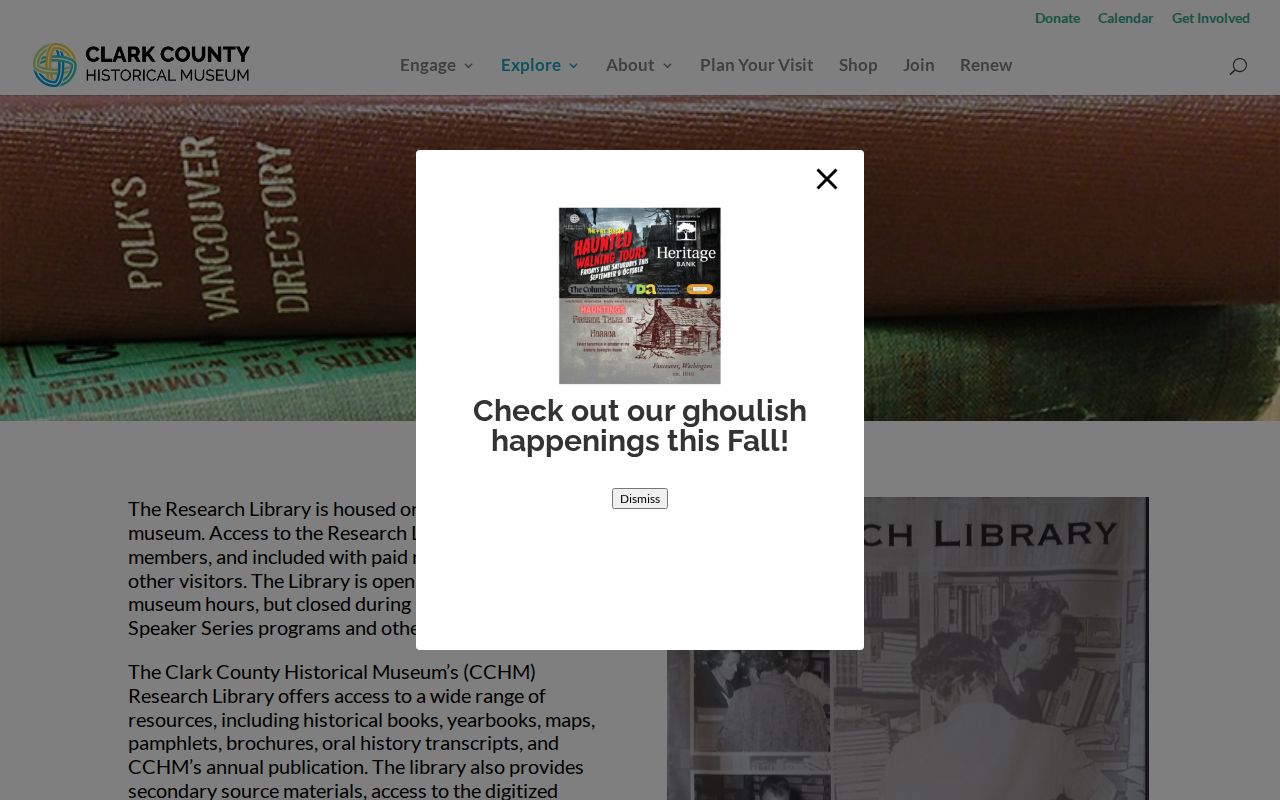
The capture confirms that the museum is a real access channel, not an assumed digital directory portal. Ask staff which Polk years and reverse sections are available before citing a complete run.
Read Orchards City Directory Entries
A printed entry is a dated snapshot. Depending on the publisher and year, it may show a personal name, spouse or household notation, occupation, street address, and owner, renter, widow, or boarding mark. The public research did not expose a scanned local sample page or publisher key. Do not assign a meaning to a short form until the key in that exact volume confirms it.
| Name | Copy the full spelling, initials, and order exactly as printed. |
|---|---|
| Household notation | Record a spouse or related notation without assuming every resident is listed. |
| Occupation | Preserve the printed trade or role as a match clue. |
| Address | Note number, directional, street type, rural route, and any unit. |
| Marks and abbreviations | Use the volume's own key before interpreting owner, renter, widow, or boarding symbols. |
Photograph the title page and abbreviation key before the entry. Then capture the full column and page number, not just one line. Nearby names can help distinguish households, businesses, and address changes. If the volume has both name and address sections, save both views.
- Criss-cross directory
- A reverse section arranged by street and house number rather than by surname.
- Householder index
- A list centered on people identified as heads of households, with coverage shaped by the publisher.
- Abbreviation key
- The publisher's legend for short forms and symbols used in that volume.
Orchards City Directories Beyond Print
Fort Vancouver Regional Libraries resources add licensed and digital tools. Ancestry Library Edition includes census, school yearbooks, vital, military, immigration, city-directory, map, newspaper, and family-history material. FIMO supplies fire-insurance maps, and HeritageQuest adds census and local-history books. Access varies: some products need a library card or an in-library session.
These companions solve different problems. A yearbook can confirm a school-age name. A census groups a household. A fire-insurance map may show the street layout and building footprint where coverage exists. Newspapers can connect a surname, church, business, subdivision, or event to a date. None should be used to invent a current Orchards resident from an old reference.
The captured FVRL resource page helps identify the current database route:
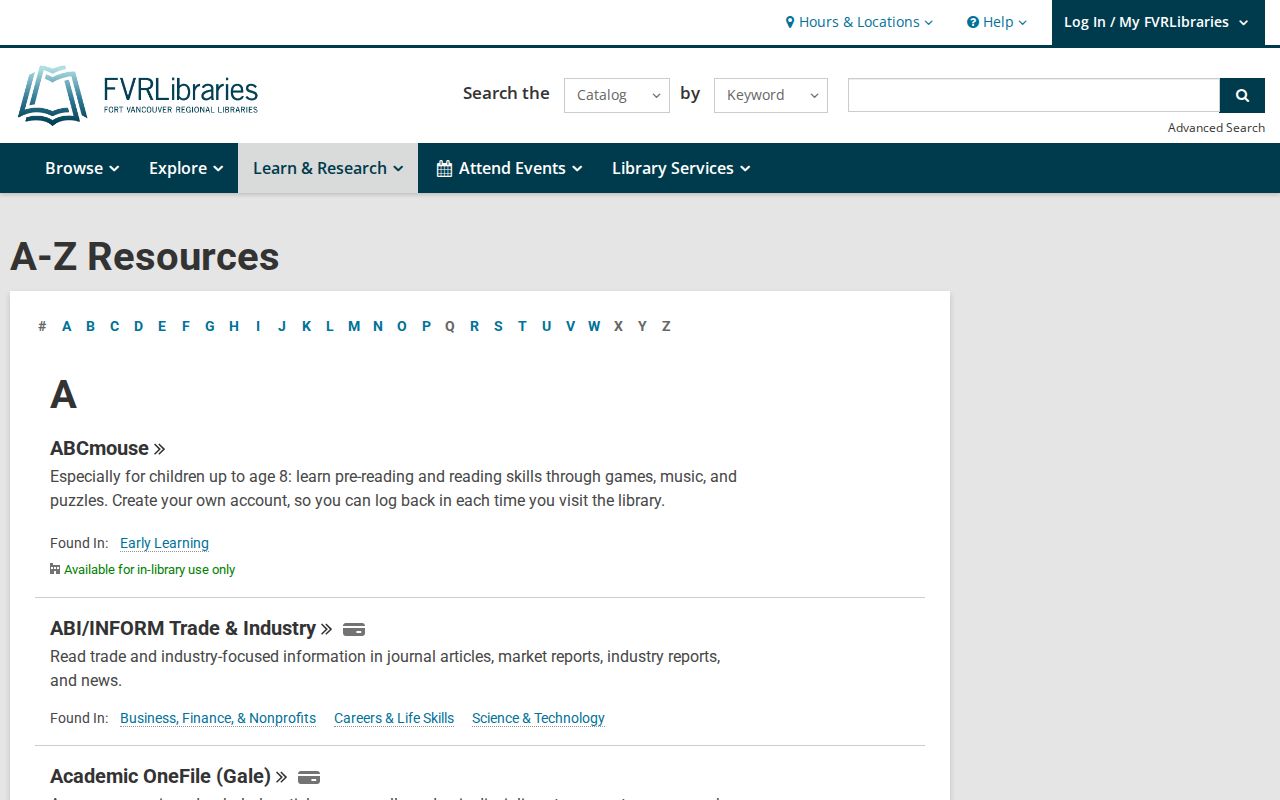
The page is an access map, not one combined index. Check whether the chosen database is available from home or only at a library location before beginning a long search.
Trace Orchards Families by Directory
A sound Orchards city directory trail starts with a dated fact and moves one source at a time. Use the closest verified directory year, then test the finding against census, deed, marriage, obituary, cemetery, or newspaper evidence. This method works for family history, an heir search, or a former-address project without treating one printed line as a full identity profile.
- Normalize the known address in county parcel or GIS records. Save the street direction, ZIP, parcel number, and legal description.
- Open the nearest verified directory year. Search the reverse section if it exists, then check the alphabetic name section.
- Copy spelling, initials, occupation, household marks, and neighboring addresses. Preserve uncertainty when two names may differ.
- Use the 1850, 1871, or 1885 census where the era fits. Add the birth register, marriage index, or naturalization file only when relevant.
- Test the address with a deed, newspaper, obituary citation, cemetery book, or home survey. Retrieve the underlying record, not just an index line.
- Log searches that returned nothing, including year, spelling, repository, and section checked.
A deed-centered modern address search belongs on the Orchards street directory. Historical volumes remain the city-directory core. Where an old address and a modern parcel differ, compare the legal description, plat, and map before declaring that the household moved.
Confirm Orchards Directory Names
The Clark County Genealogical Society library at 3205 NE 52nd Street in Vancouver is open to the public and focuses on Clark County, southwest Washington, and nearby counties. Its catalog lists local-history and cemetery material plus partial Columbian obituary indexes for 1993, 1997, and 1998. Those years describe cataloged index holdings, not guaranteed coverage of every death notice.
CCHM adds cemetery books and home surveys. The Library of Congress lists the Vancouver Independent for 1875-1910 and the Vancouver Weekly Columbian for 1920-1927. Search by surname, street, business, church, cemetery, subdivision, and event. Compare the notice date with the directory year and deed date.
An obituary index is only a citation lead. Retrieve the notice and record its newspaper, date, and page. A cemetery record may confirm dates or family ties but does not prove where someone lived in a different year. These checks are most useful when initials, former surnames, or common names create doubt.
Plan an Orchards Directory Visit
Start online, then move to the right desk. Search the state catalog and Digital Archives first. Contact CCHM about the exact Polk volume, reverse section, and visit rules. Ask CCGS whether the desired obituary or cemetery item is in its catalog. Use FVRL for licensed databases and maps. The State Library reports that access changed after July 1, 2025 to limited Thursday appointments from 1 to 4 by email, so verify the current arrangement before travel.
Historical Museum
CCHM Research Library
1511 Main Street
Vancouver, WA 98660
Collection and access details
Genealogy Library
Clark County Genealogical Society
3205 NE 52nd Street
Vancouver, WA 98663
360-750-5688
Regional Library
FVRL Administration
2018 Grand Boulevard
Vancouver, WA
360-906-5000
Bring a focused request: person or address, likely years, spelling variants, and the source already checked. Shelf staff can point to collections, but researchers should expect to read the material themselves. Cite a city directory by title, publisher, year, page, and repository.
Note: State Library appointments and licensed database access can change, so confirm the current channel before making a trip for Orchards research.