
Orchards Previous Residents by Era
An address history rarely survives in one continuous index. Start with the source closest to the period in question, then connect it to the parcel through a name, legal description, lot, date, or newspaper event. The modern recorded-land index supplies a strong recent chain. Earlier Orchards previous residents require directory, census, vital-index, and local-history evidence whose geography may predate today's street labels.
| Source | Documented years | Where held | What it can show |
|---|---|---|---|
| Land index | 1998-present; current year may be incomplete | LandmarkWeb and Washington Digital Archives | Parties, document, date, parcel and legal trail |
| Clark directories | 1918-19, 1921, 1928-29, 1931, 1934 verified | Washington State Library; Polk holdings at CCHM | Names, addresses, occupations, reverse leads where present |
| Clark census | 1850, 1871, 1885 | Washington Digital Archives | Household and demographic context with images |
| Clark birth register | 1891-1907, plus one 1884 record | Washington Digital Archives | Child and parent fields |
| Marriage series | Returns 1843-1909; certificates 1843-2021 | Washington Digital Archives | Parties, date and series-specific images |
| Obituary indexes | Partial entries for 1993, 1997, 1998 | CCGS catalog and library | Citations leading to the full notice |
These years describe collection coverage, not proof that a given Orchards address appears. The early census schedules predate modern subdivisions. The verified directories may reflect the Vancouver publishing market rather than the full present-day CDP. Record a negative search without treating it as proof that no household lived there.
Anchor Orchards Address Records
Enter the current address in the Clark County Property Information Center. Save the nine-digit PAN, situs, owner, mailing address, legal description, jurisdiction, sales, and assessment date. If the search fails, use MapsOnline, choose Identify, click the parcel, and follow the report link. County lobby computers offer an owner-name search that the remote address/PAN workflow does not.
The legal description is the bridge to an older lot or tract. A street number can be assigned after subdivision, normalized by a newer system, or omitted from an early source. No official Orchards-wide renumbering table was located, so any address change must be supported by a specific plat, deed, permit, directory, aerial, or assessor record.
Keep situs and mailing fields separate. The official sample parcel is physically in the Orchards and Maple Tree context, while its LLC owner receives mail in Santa Barbara. Its latest sale field shows zero dollars. Neither fact identifies a prior household, but both warn against turning an owner or mailing line into a resident claim.
Trace Orchards Resident Deed Records
The Clark County Auditor LandmarkWeb index offers name, document, excise number, book/page, parcel ID, record-date range, instrument number, and legal-description searches. A grantor transfers an interest; a grantee receives it. The chain of title is the linked sequence of recorded interests in a parcel. A legal description identifies land by its recorded lot, block, plat, or tract language and can outlast a street label.
- Copy the current PAN, situs, legal description, owner, mailing address, and assessment date from PIC.
- Find the latest transfer by parcel, legal description, or current grantee. Save the instrument number, record date, type, grantor, grantee, and book/page or excise reference.
- Search that grantor as a grantee in an older range. Compare every version of the legal description before accepting the link.
- Repeat the search in both party directions. Check for trusts, estates, business entities, quitclaim deeds, plats, lot mergers, and boundary changes.
- Use Washington Digital Archives for its documented 1998-present land index, then ask the Auditor counter or mail service for copies and older access when the web trail ends.
- Grantor and grantee
- The party giving an interest and the party receiving it.
- Chain of title
- The ordered trail of recorded transfers and interests tied to the same land.
- Legal description
- The filed land description used to connect records when a street address changes or disappears.
LandmarkWeb images are viewable but not certified. The Auditor provides counter and mail copies. Certified copies cost $3 for the first page and $1 for each added page; non-certified copies cost $1 per page. Those are copy charges, not the much higher fees for recording a new instrument.
The official LandmarkWeb screen appears in this Orchards previous residents research capture.
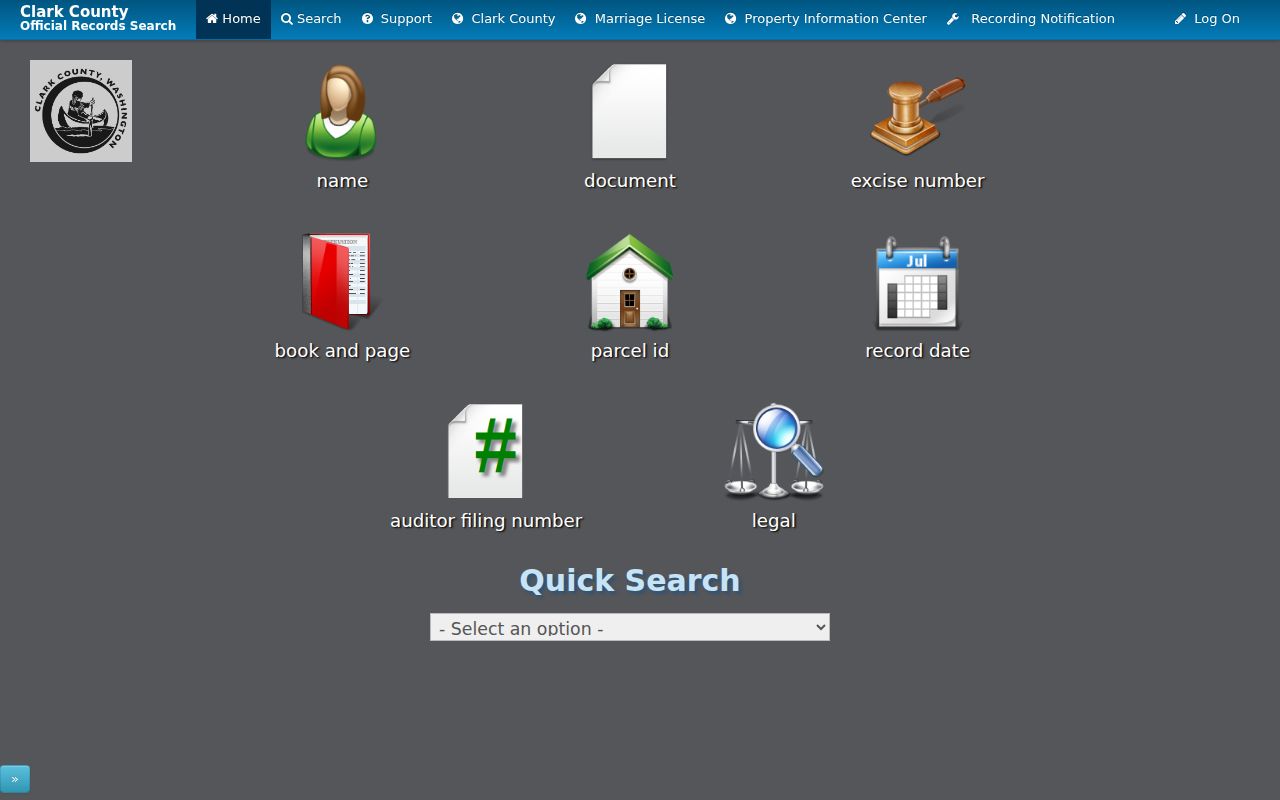
The capture marks the current index entry point; the Auditor counter and mail route remain essential for certified copies and records outside a convenient web search.
Bridge Orchards Address Records
A gap in the deed chain may be a search-key problem. Search the subdivision or addition name in Washington Digital Archives, then use the Auditor index for the plat, short plat, boundary adjustment, or related instrument. Save the plat name, lot and block, recording date, and linked parcel. A current address can then be tied to older land language without guessing that two street numbers are the same place.
Rural routes, later street numbering, new subdivisions, and limited directory coverage can all make a past resident hard to find. Search both parties around the known date, test former legal descriptions, and check nearby parcel numbers. If the evidence does not close the gap, say so. A clean open question is better than an invented household.
Note: An easement, reconveyance, lien, or release explains a recorded interest, but it does not place that party in an Orchards household.
Pair Orchards Directories and Census
Ownership is only one strand. To test who lived here before, move from the parcel's street and legal identity to the closest verified directory year. A criss-cross directory is an address-first section: locate the street and number, copy the household or business entry, then search the name in the alphabetic section. Not every volume includes that feature, so inspect the actual book.
- Choose the directory year closest to a known deed, permit, family event, or newspaper date.
- Copy the address spelling, name, initials, occupation, spouse notation, and any owner or renter abbreviation exactly as printed.
- Compare the result with the 1850, 1871, or 1885 Clark census collection when the period fits. Use household names, ages, birthplaces, and occupations as corroboration.
- Test family links in the 1891-1907 birth register, marriage series, cemetery material, and obituaries. Retrieve the underlying record or notice.
- Return to the deed or plat and document the bridge between the person, year, and land. Keep doubtful links labeled as such.
The State Library verifies Clark directory runs for 1918-1919, 1921, 1928-1929, 1931, and 1934. Clark County Historical Museum confirms Polk directories but does not publish a complete year list. Details about reading and reaching those volumes belong on the Orchards city directory page.
Orchards Resident History Shelves
The Clark County Historical Museum research library holds Polk directories, cemetery records, historical-home surveys, maps, oral histories, annuals, community histories, and digitized Columbian material. The collection is non-circulating and chiefly self-directed. Visitors should bring a pencil, camera, or hand scanner, and should expect to request some material from staff.
The Clark County Genealogical Society library adds local cemetery, family-history, and newspaper-index material. Its catalog identifies partial Columbian obituary indexes for 1993, 1997, and 1998. Fort Vancouver Regional Libraries provides in-library Ancestry Library Edition, FIMO fire-insurance maps, HeritageQuest, newspapers, maps, and yearbooks. Licensed access can require a library visit or card.
The local collection can bridge deeds to household and community evidence, but every directory, survey, and index entry still needs its own date and citation.
Map Earlier Orchards Resident Records
Fire-insurance maps can show building footprints, street names, land use, and nearby structures when a sheet covers the property. FVRL lists FIMO maps, and the Library of Congress provides a Sanborn search route. No official result identifying a specific Orchards sheet and year was found, so inspect the catalog before naming a local map date.
Newspapers add dated events. The Library of Congress lists the Vancouver Independent for 1875-1910 and Vancouver Weekly Columbian for 1920-1927. Search a surname, street, business, church, cemetery, subdivision, and event. Compare the notice date to the deed and directory timeline. An obituary index is just a citation lead; retrieve the full newspaper image or library copy.
The Clark historic-preservation research guide also points house researchers toward libraries, directories, newspapers, genealogy, and historic-property sources. No ready-made Orchards house file was confirmed. Build the packet from the parcel, plat, deed, permit, aerial, directory, obituary, map, and neighborhood history that actually match the site.
Separate Orchards Resident Record Roles
A deed proves that named parties gave or received a recorded interest on a date. A parcel card describes a site for an assessment cycle. A directory can associate a household or business with an address in a publication year. A census identifies an enumerated household within its historical geography. A newspaper or obituary documents the event stated in that item. None should be made to prove the others.
This distinction matters when a result names an LLC, trust, estate representative, or distant mailing address. Retrieve the instrument before attaching a person to the property. Even a zero-dollar consideration field does not explain whether a transfer was a gift, correction, estate act, or another transaction.
House-history rule. Use the smallest public detail needed to document the Orchards address trail, and leave living people's unrelated personal details out.
Close the Orchards Household Trail
A sound conclusion names the proposition and the date: recorded owner, directory household, census household, permit party, obituary subject, or cemetery reference. If the address is absent, preserve the failed search and test older legal descriptions or nearby numbers. Directory publication gaps, rural routes, index omissions, a later subdivision, or a missing map sheet can all explain a blank result.
Past residents may leave Orchards before an obituary appears, and probate papers may be held as Superior Court records rather than land records. Use the Washington Courts index as a lead, then request the official file from the Clark County Clerk when public access permits. A same surname or nearby address is not enough to merge two people.
The final timeline should keep citations next to each fact. Include the source keeper, collection or instrument, year or date, page or image reference, search spelling, and access date. Mark each uncertain link. That format lets another family or property researcher repeat the work without exposing more about a living person than the question requires.
Lawful use. Orchards previous residents research is for lawful house history, family history, estate work, and personal curiosity. Never use a record to track, stalk, harass, threaten, or harm anyone.